
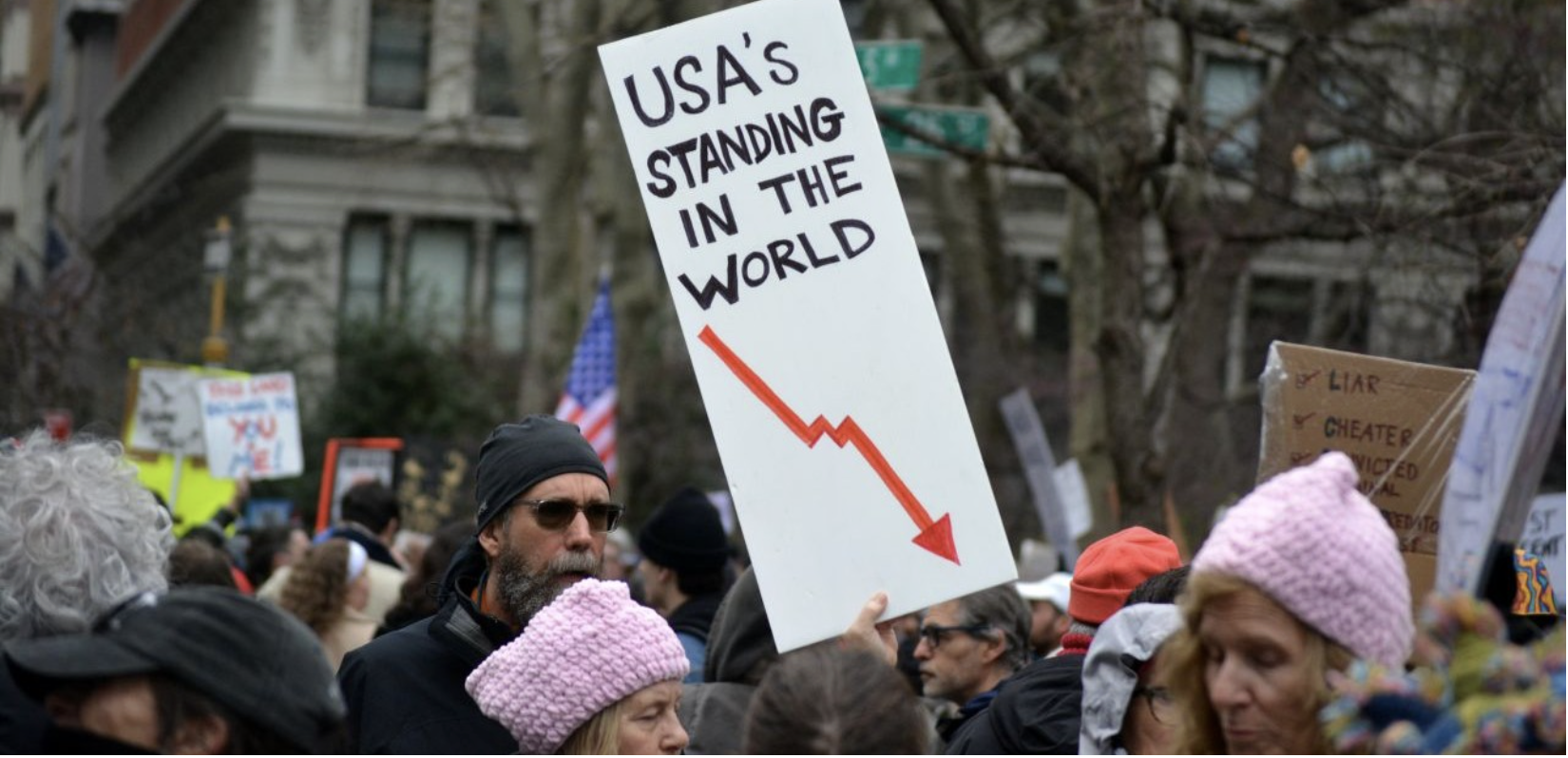
For decades, the United States stood on the world stage delivering sermons on democracy, capitalism, and human rights. It lectured nations into adopting its model under the banner of American exceptionalism. In 2025, a startling spectacle emerges: the nation that proclaimed itself democracy’s global arbiter now displays the very symptoms of authoritarianism it once denounced.
The American Gospel: A Sermon of Freedom
American exceptionalism has fuelled U.S. foreign policy for over a century. It is a story of a nation uniquely devoted to liberty, a “shining city upon a hill” destined to lead the world toward democracy. As one scholar notes, American exceptionalism carries “a special responsibility to exert global leadership…promote democracy and human rights.”¹ This belief justified countless interventions, sanctions, and foreign policy doctrines.
The messianic impulse peaked after the Cold War. The Soviet Union’s collapse was framed as democracy’s ultimate triumph. The “end of history” was proclaimed. From boardrooms to United Nations halls, the gospel of free markets and free elections was preached with unwavering conviction. President Ronald Reagan revived a moralised foreign policy that cast the United States as democracy’s divinely favoured guardian—a nation “set apart” to confront tyranny. Reagan’s rhetoric made democracy promotion not only a strategic objective but a patriotic duty, fusing national identity with global mission. As Reagan himself declared, “We want to promote democracy, because it is right.”²
Beneath this righteous facade lies a history that contradicts America’s stated ideals.
A History of Hypocrisy: Do as I Say, Not as I Do
Since World War II, whilst lecturing the world on democracy, America engineered the downfall of democratically elected governments that challenged its interests. The CIA became the instrument of a foreign policy that preached democracy whilst actively subverting it. The record is damning:
| Country | Year | Target | U.S. Action | Outcome |
| Iran | 1953 | Prime Minister Mohammad Mossadegh | CIA-backed coup (Operation Ajax), funded by US and UK to prevent nationalisation of oil industry | Overthrow of democratic leader; restoration of Shah’s authoritarian rule; CIA officially acknowledged coup as ‘undemocratic’ in 2023.³ |
| Guatemala | 1954 | President Jacobo Árbenz | CIA-sponsored coup (Operation PBSUCCESS) to protect United Fruit Company interests and counter perceived communist influence | End of Guatemalan Revolution; military dictatorship; sparked a brutal 36-year civil war that killed over 200,000 people, 83% of them Mayan civilians.⁴ |
| Congo | 1961 | Prime Minister Patrice Lumumba | CIA authorised assassination to prevent Soviet alignment during Cold War; first US order to kill a foreign leader | Assassination of democratic leader; decades of instability.⁵ |
| South Vietnam | 1963 | President Ngo Dinh Diem | Kennedy administration backed coup by South Vietnamese generals due to Diem’s unpopularity and ineffective governance during Vietnam War | Assassination of president and his brother; escalation of Vietnam War.⁶ |
| Brazil | 1964 | President João Goulart | US-backed military coup to prevent leftist reforms; Operation Brother Sam prepared military support | Brutal military dictatorship lasting until the 1980s.⁷ |
| Dominican Republic | 1965 | Supporters of Juan Bosch (democratically elected president overthrown in 1963) | Direct US military invasion—22,000 troops deployed to prevent ‘second Cuba’ and block Bosch’s return to power | US occupation until September 1966; President Johnson later regretted intervention.⁸ |
| Indonesia | 1965-66 | President Sukarno; Indonesian Communist Party (PKI) | Support for Suharto’s coup to eliminate communist influence; US provided lists of communists to be killed | Mass killings of 500,000 to 1 million people; 32-year Suharto dictatorship.⁹ |
| Chile | 1973 | President Salvador Allende | $8 million in covert operations; economic warfare; CIA funding of opposition to prevent ‘Marxist’ government | Overthrow and death of elected leader; Pinochet dictatorship; 3,000+ killed, 38,000 tortured.¹⁰ |
| Argentina | 1976-83 | Leftists, suspected communists, dissidents | Support for military junta during ‘Dirty War’ to combat leftist insurgency | 30,000 people disappeared or killed; Argentine military believed it had US approval.¹¹ |
| El Salvador | 1980s | Leftist guerrillas (FMLN) | Military aid to government forces, including the training of the Atlacatl Battalion, to prevent communist takeover | Death squads killed thousands; the El Mozote massacre, carried out by the Atlacatl Battalion, resulted in the slaughter of 800-1,000 civilians, including hundreds of women and children.¹² |
| Nicaragua | 1980s | Sandinista government (FSLN) | Funded and trained Contra rebels to overthrow socialist government. The Reagan administration secretly continued funding after Congress prohibited it, leading to the Iran-Contra scandal | Guerrilla war 1979-1990; Iran-Contra scandal.¹³ |
This list is not exhaustive. Historians have documented nearly 400 U.S. military interventions throughout American history.¹⁴ The pattern is unmistakable: when democracy conflicted with American interests or Cold War paranoia, democracy was expendable.
Henry Kissinger’s admission to Nixon about the Chilean coup captures the duplicity: “We didn’t do it. I mean we helped them…created the conditions as great as possible.”¹⁰ A public face of democratic idealism masked a shadow reality of ruthless pragmatism. In Indonesia, the U.S. provided lists of suspected communists to be killed in one of the 20th century’s worst mass murders.⁹ In Argentina, the military junta believed it had explicit U.S. approval for its “Dirty War,” with Kissinger again playing a central role.¹¹
The justifications were always identical: fighting communism, protecting American interests, preventing instability. The results were consistently catastrophic. Torture, disappearances, death squads, and decades of authoritarian rule became the legacy of American “democracy promotion.”
To be fair, the United States has at times supported genuine democratic transitions, particularly in post-war Germany and Japan, and through diplomatic pressure on authoritarian allies in the 1980s. However, these instances are exceptions that prove the rule. They are vastly outnumbered by cases where strategic and economic interests routinely trumped democratic principles, often with devastating consequences for the countries involved.
The Authoritarian Boomerang: Chickens Coming Home to Roost
The tools America used to undermine democracies abroad have now turned inward. A recent survey of over 500 political scientists revealed a “precipitous drop” in assessments of U.S. democracy, with many concluding the nation is on a “fast slide into what’s called ‘competitive authoritarianism.’”¹⁵
Trump’s second-term actions mirror the authoritarian playbook America once wrote for others. Attacks on media and threats to revoke broadcast licences mirror Viktor Orbán’s tactics in Hungary, a leader Trump openly admires.¹⁵ The mass firing of federal workers echoes the purges carried out by Latin American military juntas America supported.¹⁶ Weaponising the Justice Department to target opponents—indicting New York Attorney General Letitia James and former FBI Director James Comey—recalls the political prosecutions of the “Dirty Wars” America funded in Argentina and El Salvador.¹⁷
Over 340 former intelligence and national security officials warn the U.S. is “on a trajectory” toward authoritarian rule, with democratic backsliding “accelerating.”¹⁷ These are not partisan figures, but career professionals who have spent decades analysing threats to democracy around the world. Now they apply those frameworks to their own country. As one former CIA analyst observed: “The speed with which we have devolved away from a fully functioning democracy is startling. In most cases, it takes longer than nine months to get where we are.”¹⁵
The indicators are textbook: expansion of executive power, politicisation of civil service, erosion of judicial independence, weakening of Congress, manipulation of electoral systems, and the undermining of press freedom.¹⁷
The World Is Watching: The End of American Exceptionalism?
The world has stopped listening to America’s sermons. The hypocrisy has become too glaring. A 2025 Pew Research Center survey found U.S. image declining in many nations, with majorities in 19 of 24 countries lacking confidence in Trump’s leadership.¹⁸ Most international respondents describe him as “arrogant and dangerous,” whilst few see him as honest.¹⁸ America is losing its moral authority and, with it, its ability to lead.
The question one headline posed cuts to the core: “Is America Seriously Going to Lecture Other Countries About Democracy Now?”¹⁹ The answer, increasingly, is no. Nations once targeted by American intervention now watch with a sense of alarm and grim satisfaction as the empire’s clothes are stripped away. Countries told they weren’t “ready” for democracy witness the supposed beacon of freedom teetering toward authoritarianism.
The irony cuts deep. America overthrew Mossadegh to protect oil interests, then spent decades condemning Iran’s authoritarianism. It backed brutal military dictatorships across Latin America, then lectured those countries about human rights. It provided kill lists for Indonesian massacres, then positioned itself as humanity’s champion. Now, as it slides toward the authoritarianism it once exported, the world watches with tragic inevitability.
Conclusion: A Cautionary Tale
The United States now confronts a profound irony. For decades, it positioned itself as democracy’s champion whilst systematically undermining democratic governments that threatened its interests. The hypocrisy was always evident to those on the receiving end of American intervention—the families of the disappeared in Argentina, the survivors of massacres in Guatemala and El Salvador, the citizens of Iran still living under the authoritarian regime that followed the CIA-backed coup.
What has changed is not the contradiction itself, but its visibility. As America exhibits the authoritarian tendencies it once condemned in others, the gap between rhetoric and reality has become impossible to ignore. Nations that were lectured about democracy now watch as the lecturer dismantles democratic norms at home. The moral authority that once gave apparent weight to American pronouncements has evaporated.
Yet even as America’s domestic crisis unfolds, its problematic global role continues in a new guise. The Trump administration is actively bolstering the move towards autocracy in various parts of the world, lending legitimacy to authoritarian leaders and undermining democratic institutions abroad. The capacity to do harm has not diminished—it has merely transformed. Venezuela may well be next for American gun boat diplomacy.
The question is no longer whether America can credibly lecture others about democracy. That ship has sailed, weighed down by decades of coups, death squads, and support for dictators. The question now is whether the United States will learn from its own contradictions—or become a cautionary tale studied by those who once looked to it for guidance. History has handed the United States a rare chance to confront its past and align its power with its principles. Whether it seizes that opportunity will determine if America remains a model or becomes a warning for democracies worldwide.
Bibliography
- McManus, Doyle. “A Brief History of American Exceptionalism.” Yale University Press, February 28, 2017. https://yalebooks.yale.edu/2017/02/28/a-brief-history-of-american-exceptionalism/.
- Reagan, Ronald. “Remarks at a White House Briefing for the Citizens Network for Foreign Affairs.” Ronald Reagan Presidential Foundation & Institute, October 7, 1987. https://www.reaganfoundation.org/ronald-reagan/quotes/we-want-to-promote-democracy-because-it-is-right-and.
- “In First, CIA Acknowledges 1953 Coup It Backed to Overthrow Leader of Iran Was Undemocratic.” PBS NewsHour, October 12, 2023. https://www.pbs.org/newshour/world/in-first-cia-acknowledges-1953-coup-it-backed-to-overthrow-leader-of-iran-was-undemocratic.
- “Timeline: Guatemala’s Brutal Civil War.” PBS NewsHour, March 7, 2011. https://www.pbs.org/newshour/health/latin_america-jan-june11-timeline_03-07.
- Reid, Susan. “How the U.S. Issued its First Ever Order to Assassinate a Foreign Leader.” Politico, October 17, 2023. https://www.politico.com/news/magazine/2023/10/17/patrice-lumumba-congo-washington-00121755.
- “Evidence on the Diem Coup in South Vietnam, November 1963.” National Security Archive, November 1, 2020. https://nsarchive.gwu.edu/briefing-book/vietnam/2020-11-01/new-light-dark-corner-evidence-diem-coup-november-1963.
- “The United States and Brazil’s Military Coup (1964).” Library of Congress, May 1, 2024. https://guides.loc.gov/brazil-us-relations/brazil-coup-1964.
- “The Dominican Intervention.” National Security Archive, April 28, 2015. https://nsarchive2.gwu.edu/NSAEBB/NSAEBB513/.
- “Declassified files outline US support for 1965 Indonesia massacre.” National Security Archive. https://nsarchive.gwu.edu/.
- Kornbluh, Peter. “Chile coup 50 years later: The U.S. role and its unintended consequences.” NPR, September 10, 2023. https://www.npr.org/2023/09/10/1193755188/chile-coup-50-years-pinochet-kissinger-human-rights-allende.
- Kornbluh, Peter. “Argentina’s Military Coup of 1976: What the U.S. Knew.” National Security Archive, March 23, 2021. https://nsarchive.gwu.edu/briefing-book/southern-cone/2021-03-23/argentinas-military-coup-what-us-knew.
- “Remembering US-backed state terror in El Salvador.” Al Jazeera, December 11, 2021. https://www.aljazeera.com/opinions/2021/12/11/remembering-us-backed-state-terror-in-el-salvador.
- “Understanding the Iran-Contra Affairs.” Brown University. https://webhelper.brown.edu/cheit/Understanding_the_Iran_Contra_Affair/n-contrasus.php.
- “U.S. Foreign Policy Increasingly Relies on Military Interventions.” Tufts Now, October 16, 2023. https://now.tufts.edu/2023/10/16/us-foreign-policy-increasingly-relies-military-interventions.
- Langfitt, Frank. “U.S. is sliding toward authoritarianism, hundreds of scholars say.” NPR, April 22, 2025. https://www.npr.org/2025/04/22/nx-s1-5340753/trump-democracy-authoritarianism-competive-survey-political-scientist.
- Hsu, Andrea. “Judge indefinitely halts shutdown layoffs noting human toll.” NPR, October 28, 2025. https://www.npr.org/2025/10/28/nx-s1-5585083/government-shutdown-trump-rif-layoffs.
- Borger, Julian. “US ‘on a trajectory’ toward authoritarian rule, ex-officials warn.” The Guardian, October 16, 2025. https://www.theguardian.com/us-news/2025/oct/16/trump-authoritarianism-warning.
- Wike, Richard, Jacob Poushter, Laura Silver, and Janell Fetterolf. “US Image Declines in Many Nations Amid Low Confidence in Trump.” Pew Research Center, June 11, 2025. https://www.pewresearch.org/global/2025/06/11/us-image-declines-in-many-nations-amid-low-confidence-in-trump/.
- Keating, Joshua. “Is America Seriously Going to Lecture Other Countries About Democracy Now?” Slate, January 7, 2021. https://slate.com/news-and-politics/2021/01/biden-global-democracy-summit.html.
This article was first published on the Toda Peace Institute site.
