
India Map
Dynamics of Opposing Visions in India
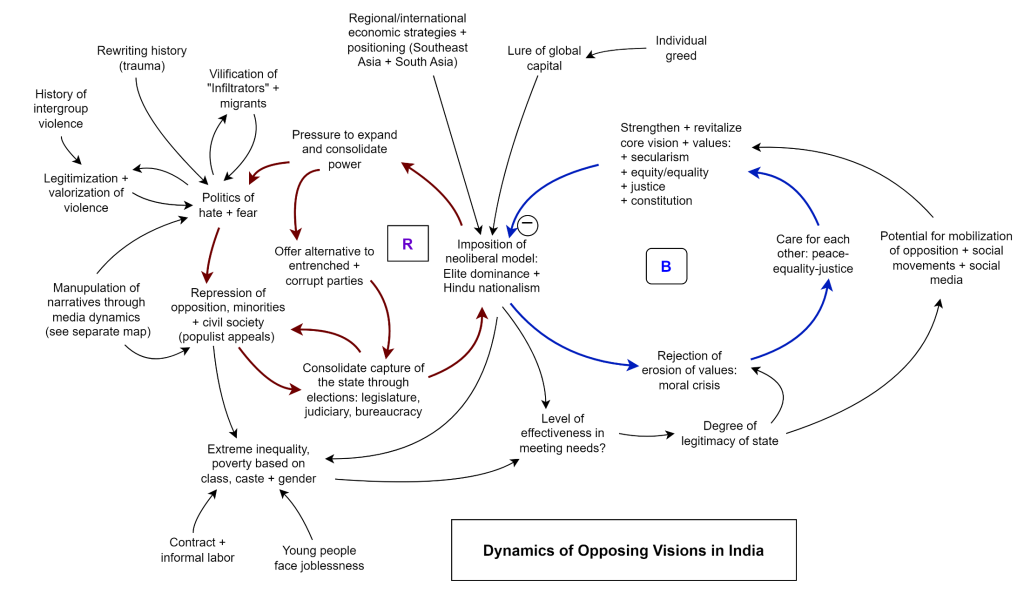
The systems map of the dynamics of power and change in India, shows the governing powers and opposition forces presenting competing visions for the future of the nation. These are represented in two cycles—one a reinforcing loop depicting the spiral of increasing control and repression by the dominant party, and the other a balancing loop revealing resurgent political parties and social movements that reject the politics of hate and assert the values enshrined in the constitution. These dynamics are explained below.
Politics of Fear and Repression: a reinforcing loop
The systems loop on the left side of the diagram, labelled with an “R”, shows how the dominant political forces (the BJP party and the RSS and their allies) are locked in an ever-expanding cycle that consolidates power and brings personal gain of wealth and influence to their allies and cronies. They are energized by a neoliberal ideology incentivized by global capital and Asian regional economic forces. The neoliberal model is mixed with elite dominance and Hindu nationalism that help expand power and influence. They then turn to the politics of hate and fear as a primary instrument for mobilizing the Hindu majority against minority groups vilified as threats and characterized as “invaders” or “infiltrators.” The ideology of hate and fear draws upon a long history of trauma going back to the founding of the state, including partition at the creation of India and Pakistan, as well as historical references to Muslim empires. Periodic intergroup violence has become legitimized over time, normalized and even valorized in the dominant narratives and reinforced through manipulation of the media.
As a result, in the current situation, we see increasing repression of minorities, particularly Muslims, but other groups as well. Civil society groups, especially those that challenge repressive policies and persistent inequality, experience restrictions and even persecution. Repression, arrest and imprisonment of opposition figures and human rights voices enables further consolidation of power and, ultimately, capture of democratic structures including media and state institutions, such as the legislative, judicial, and bureaucratic bodies, as well as the security apparatus. Such control, in turn, reinforces imposition of the neoliberal economic model. It must be said that the BJP offers an alternative to older parties that are perceived as corrupt and failing to meet the needs of the population.
At the same time, extreme inequalities persist, leading, over time, to questioning of the ability of the state to meet the basic needs of citizens and, therefore, the legitimacy of the state itself. In some circumstances, autocratic leaders (local and national) can exploit misery by offering short-term handouts that reinforce their voter bases. However, the persistent failure to meet needs also provides impetus to opposition social movements.
Projection of an Opposing Vision: a balancing loop
On the righthand side of the diagram, we find a balancing loop (B) that tends to blunt the effects of the reinforcing loop (indicated by the minus sign where the B loop intersects with the R loop). Human rights and social change activists and, to a certain extent, opposition political parties, reject the politics of fear and hate and emphasize fundamental values of mutual care, peace, equality and justice. They advocate strengthening and revitalization of the core vision and values articulated in the constitution, including secularism, equity/equality and justice. This vision challenges the underlying values of the dominant forces—thereby exhibiting potential for “balancing” against the politics of hate and fear.
Capture and Control of Media in India
The basic dynamics of opposing visions presented above are reinforced by increasing control over the media, both traditional media (newspapers, TV…) and social media outlets, as shown in the detailed diagram below.
We see two intersecting reinforcing loops. R1 in the diagram reflects the effects on individual journalists. As the regime feels threatened by challenges to its control, it engages in threats and legal claims against individual journalists and media outlets. Such threats may result in several possible actions (shown with dotted arrows, as there is no single dynamic, but a possible range), including self-censorship from intimidation, actual arrest and jailing of individuals, and expulsion of foreign correspondents. The cumulative effect of these actions is that alternative voices are silenced and the level of effective accountability of the regime is reduced. As the media is unable to perform one of its functions (holding officials accountable), the ongoing abuses of an anti-democratic regime go unchecked. Still, some non-mainstream and digital media houses or individuals will conduct investigations, posing a threat to regime control.
We do see (B1 loop) that these dynamics (control of individual journalists) can be resisted through “digital mutinies” that publish online critiques (publications or YouTube videos) and the use of social media to check facts and protest violations of rights.
Meanwhile, the regime engages in another set of actions that increases its control over the media. The R2 loop at the top of the diagram depicts another response of the regime to threats. In most cases, the party does not purchase media outlets directly, rather powerful and wealthy friends of the regime buy out media houses. Other media leaders simply fall in line with the government line to avoid tax scrutiny or other legal/financial challenges. This allows the regime to control the dominant media narratives and to use technology to feed addictive information to the public. The public, in response, voluntarily limits its exposure to alternative information and opinions and increases its support for the government. As a result, the scope for engaging in polarizing hate speech and populist appeals increases, again enhancing support for the regime among its supporters and permitting anti-democratic actions and policies.
The level of support for the regime is reinforced (R3) by ongoing use of the media to manipulate fear, hatred, and false rumors against minorities and civil society organizations that challenge the regime—leading to physical attacks on minority communities.
