
Europe/Asia
Albania
The Center for the Study of Democracy and Governance believes in the necessity of radical transformation of democratic processes in Albania and the need to establish new ways of governing and doing politics at local and national levels. The Centre is committed to develop programs that link democracy and governance with the citizens’ concerns. CSDG’s approach starts by identifying the issues that matter and then carrying out rigorous research that serves to advocate and stimulate debates at all levels of the society. CSD’s mission is to improve democracy, governance and policy making in Albania by generating evidence based research, monitoring public attitudes and opinions, and by promoting an informed engagement of the citizen.

Tirana
European Movement Albania
Since its establishment, EMA’s policy work has been focused on multi-prong themes related to the promotion and strengthening of the democratization process of Albania. EMA believes in civic education and enhanced participation in public life from the part of non-state actors and citizens as a means to increase institutional transparency and accountability. We work in this direction with central and local government. We continuously carry out capacity building, monitoring and budget monitoring activities with a view to enhancing democracy and good governance in Albania as key EU standards.

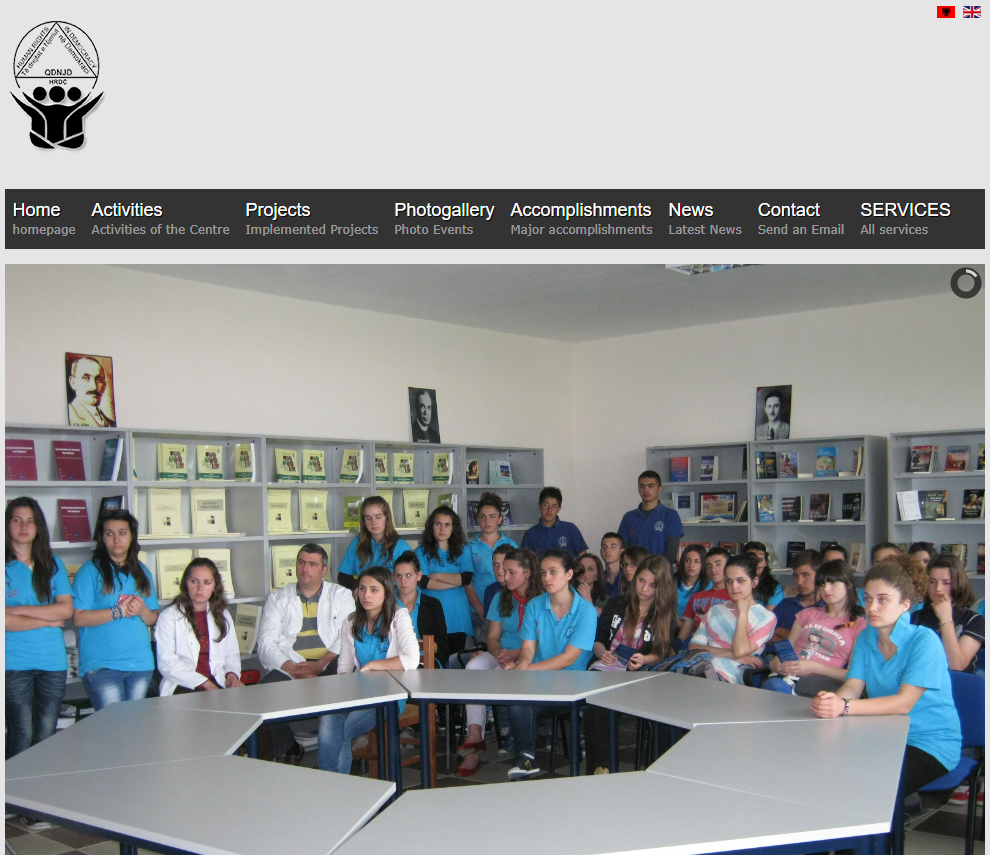
Human Rights in Democracy Center (HRDC) is non-governmental, non-partisan and non-profit organization aiming to work for the respect, protection and fulfilment of human rights in Albania, and awareness of the Albanian society about the rule of law and human rights, with particular focus on vulnerable groups of society. HRDC is an independent and autonomous institution standing on the forefront for the promotion and protection of human rights in Albania. Its mission is to strengthen democracy through advocacy, lobbing, monitoring, litigation to improve legislation and to empower vulnerable groups through education, awareness, training, capacity building, with special focus on women.
Armenia
Vanadzor
Helsinki Citizens’ Assembly-Vanadzor
Helsinki Citizens’ Assembly-Vanadzor is a non-governmental human rights organization that unites individuals who value democracy, tolerance, pluralism and principles of human rights supremacy. The Organization was founded in 1998 as an HCA Armenian Committee branch and has operated as a separate organization since 2001.

TIAC’s mission is to promote good governance and democratic processes for the sake of strengthening statehood and a corruption-free Armenia. The organization’s efforts are aimed at promoting systemic change at the local and national levels and not at protecting individual interests. During its twenty years of activity, TIAH has become a leading non-governmental organization in Armenia that supervises in the fields of effective governance and fight against corruption.

Azerbaijan
EMDS is an independent and impartial non-governmental organization working towards the holding of free and fair elections and the development of civil society and democracy in Azerbaijan. EMDS aims to also increase citizen participation in public administration, promote political pluralism and democratic values, and enhance the accountability of government bodies.

Belgium
CEPS is a leading think tank and forum for debate on EU affairs, ranking among the top think tanks in Europe. At CEPS, researchers perform policy research on a wide range of policy areas: from the economy and finance to better regulation, the digital economy and trade, as well as energy and climate, education and innovation, foreign policy and the European integration process, or justice and home affairs.

Brussels
Democratic Society
Democratic Society is a network of people working to create a democracy that works for the 21st century. The organisation undertakes practical projects, conduct research and build new democratic infrastructure that lets people involve themselves in the decisions that shape their lives.

Brussels
European Foundation for Democracy
The European Foundation for Democracy is a policy institute that has been working with civil society, academics, government and other stakeholders on the prevention of radicalisation for more than a decade. The foundation addresses all forms of radicalisation which can lead to violent extremism regardless of the political or religious ideology that may drive this. Specifically, we support initiatives to strengthen the resilience of communities in different countries by empowering credible pro-democratic voices to prevent radicalisation from gaining a foothold. To achieve this, they create practical tools to support front-line professionals (teachers, social workers, NGOs etc.) by developing practitioners’ guides for prevention work.

Brussels
European Partnership for Democracy
The European Partnership for Democracy (EPD) is a network with a global remit to support democracy. In 2008, several organisations came together to create EPD as a partnership to reinforce European democracy support by building a community that advocates and acts for democratic values around the world. EPD works inside and outside Europe because we recognise that democracy is a universal aspiration and that the contemporary challenges and opportunities for democracy are global in scope.

FIDE is a network of leading democratic innovators addressing the challenges of our time. FIDE advises governments and policymakers on how to involve everyday people in the decision-making process. As a non-partisan organization with no topical preferences, FIDE simply believes that a diverse group of citizens can reach informed judgements and propose meaningful policy recommendations.

Bangladesh
Bangladesh
Odhikar
The principal objectives of the organisation are to raise the awareness of human rights and its various abuses, on the one hand and to create a vibrant democratic system through election monitoring on the other. The organisation also performs policy advocacy to address the current human rights situation.

Bosnia and Herzegovina
Sarajevo
Boris Divković Foundation
The Boris Divković Foundation was founded in 2013 with the aim of improving political science and political practice in Bosnia and Herzegovina and the region. Since then, the Foundation has been promoting a responsible policy that serves all citizens and operates on the principles of equality, coexistence and solidarity. The foundation’s mission is to carry out ideological decontamination of the concept of politics in the public space and thus create preconditions for the inclusion of honest and responsible people in political processes in the Western Balkans.
Bulgaria
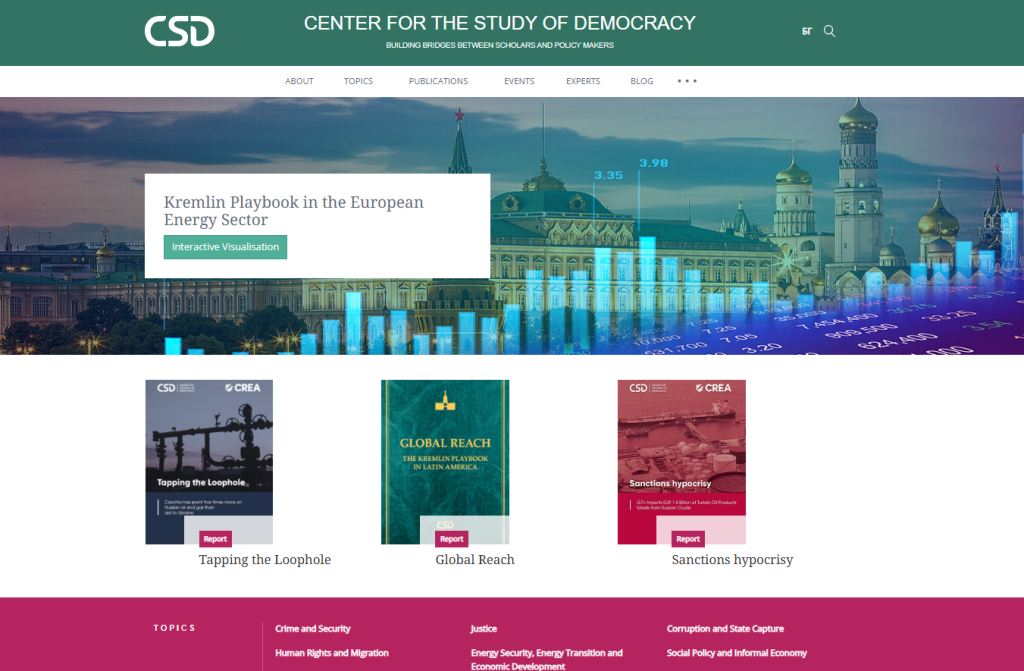
Founded in 1989, the Center for the Study of Democracy (CSD) is a public policy institute fostering the reform process in Europe through impact on policy and civil society. CSD’s mission is “building bridges between scholars and policy-makers” and as an independent, interdisciplinary think tank it combines a broad range of capacities.
LIPA is a Bulgarian non-governmental organisation, a think tank, with the non-profit purposes of promoting the expansion of liberal democracy and active civil society in Bulgaria, supporting the proper integration of Bulgaria within the EU, contributing to EU cohesion and strengthening European citizenship and identity on the merits of freedom, personal responsibility and the rule of law.

Cambodia
COMFREL’s mission is to help to create an informed and favourable climate for free and fair elections through lobbying and advocacy for a suitable legal framework, education to inform voters of their rights and monitoring activities that both discourage irregularities and provide comprehensive monitoring data to enable an objective, non-partisan assessment of the election process, and for meaningfulness of post elections through education and public forums to encourage citizens to participate in politics and decision-making.

Czechia
Prague
Forum 2000
The Forum 2000 Foundation pursues the legacy of Václav Havel by supporting the values of democracy and respect for human rights, assisting the development of civil society, and encouraging religious, cultural and ethnic tolerance. It provides a platform for global leaders, as well as thinkers and courageous individuals from every field of endeavour, to openly debate and share these critical issues.

Denmark
Copenhagen
Alliance of Democracies Foundation
The Alliance of Democracies Foundation is a non-profit organization dedicated to the advancement of democracy and free markets across the globe. The premise of the Alliance of Democracies is to strengthen the spine of the world’s democracies, to encourage greater cooperation between nations who share common values, to counter spoilers and support those who wish to bring more democracy to their countries. As the world enters a period of technological revolution and disruption, we need to ensure tech is being used for benign purposes and that it enhances democratic processes.

Copenhagen
Danish Cultural Institute
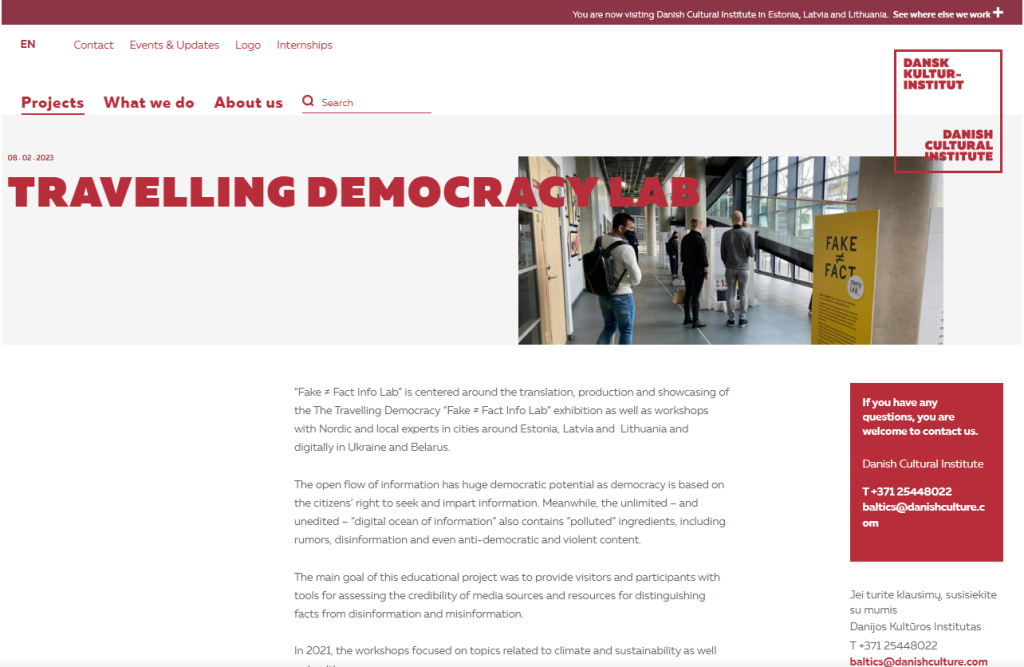
The Danish Cultural Institute promotes cultural exchanges between Denmark and the rest of the world. It supports projects aimed at long-term cooperation between foreign and Danish cultural institutions, artists and other professionals. One such project is the travelling democracy lab, an educational project that provides visitors and participants with tools for assessing the credibility of media sources and resources for distinguishing facts from disinformation and misinformation.
DIPD works in partnerships to support mutual inspiration and learning between political parties in Denmark and in developing countries. DIPD strives to make political parties more inclusive and more politically and organizationally well-functioning. DIPD works to develop and further democratic institutions in political systems and civil society, focusing especially on young people’s and women’s political participation.
DIPD collaborates first and foremost with political parties, political movements, and cross-party platforms, but also with civil society actors, the media, and other actors. The criteria for DIPD’s collaborators are that they take part in the democratic process and commit themselves to promoting democratisation.

Copenhagen
We Do Democracy
We Do Democracy are independent expert advisors on democracy and participation. We are a Nordic leader in democracy innovation, large-scale involvement and deliberative participation processes. We advise and collaborate to create a better democratic future for more people. We have conducted and facilitated over 20 citizen gatherings and citizen things. We actively participate in an international network of democracy experts and are always looking for partners to develop and implement innovative democracy formats that can develop new democratic solutions for the future.

Estonia
DD foundation believes that if there is a pluralism of ideas at the highest level, it enables pluralism in the whole society by allowing free thought and discussion, academic exploration, artistic expression, entrepreneurial activity etc, leading to all kinds of social, cultural and technological innovation. This is why we believe these institutions are the most fundamental precondition for humanity to be able to adapt to face any challenge (ecological, technological etc) and survive and thrive in the long term.

Tallinn
e-governance academy
eGA’s mission is to increase the prosperity and openness of societies through digital transformation. For this purpose, we analyse information, create knowledge about e-governance and digital transformation, and transfer Estonian and international best practices to governments and other stakeholders around the world. eGA partners with organisations to build successful digital societies that improve their citizens’ lives, strengthen their economies, and deliver transparent, democratic, and effective public administrations.

Open Estonia aims to build vibrant and tolerant democracies whose governments are accountable to their citizens. In order to achieve this goal, the Foundation runs and supports a range of initiatives to advance openness and democratic practice in decision-making processes, substantive and inclusive civil dialogue in society, and human dignity. The foundation helps shape and advocate public policies and actions that assure greater justice in society and promote fundamental rights.

Finland
Architectural Democracy is a working group of researchers and professionals that explore the relationship between architecture and democracy to make cities more understandable to all stakeholders.

Helsinki
Demo Finland
Demo Finland is an ideologically, party-politically and religiously non-committed cooperation organization of Finnish parliamentary parties founded in 2005. It works to promote democracy by strengthening the political participation of women, young people and people with disabilities in particular, and by supporting dialogue between parties. Demo Finland is also the leading democracy support expert and influencer organization in Finland.

Helsinki
Demos Helsinki
Demos Helsinki is a globally operating, independent think tank. We conduct research, offer a range of services, including strategy, capacity-building and training among other things, and host a global alliance of social imagination called Untitled. Since day one, our community has been built on the idea that change can only happen together. That is why we carry out direct engagements and research projects with hundreds of partners around the world. Unlike many think tanks, we are predominantly project-funded and fully independent, without any political affiliations.
Helsinki
Kalevi Sorsa Foundation
Kalevi Sorsa Foundation is a social democratic think tank based in Helsinki, Finland. The foundation’s objective is to promote public debate on equality and democracy and to produce research and publications. The foundation’s work proceeds from the ideas of social democracy; we ask how freedom, equality, and solidarity can be realised in public policy today and tomorrow. The think tank’s activities take place at the intersection of research, politics, and decision-making. The foundation publishes studies and reports, organises events, and participates in different ways in the public discussion.
France
The Center for Critical Democracy Studies (CCDS) promotes the practice, study and life of democracy both within and beyond the American University of Paris. The Center builds on AUP’s mission to educate global citizens by exploring fundamental and practical questions of emancipatory political life through talks, conferences and lectures with international guests; sponsorship of courses and events across campus; and its publication of The Tocqueville Review/La Revue Tocqueville.

Strasbourg
European Association for Local Democracy
The European Association for Local Democracy (ALDA) is an organisation dedicated to promoting good governance and citizen participation at the local level. ALDA focuses on activities that facilitate cooperation between local authorities and civil society in the European Union and its Neighbourhood.

Paris
Foundation de France
Fondation de France is committed to the idea that in order to defend human rights, we must preserve democracy and thus strengthen the resilience of civil society. To that end, it works towards reinforcing capacity in civil society organizations.

The Francophonie is an institutional mechanism dedicated to promoting French and implementing political, educational, economic and cultural cooperation within the 88 States and governments of the International Organisation of La Francophonie (OIF). The support of the OIF consists of supporting all actors involved in electoral processes. Peaceful political life also requires the existence of a real civil society, which today has taken its rightful place in the institutional system of the Francophonie.

Georgia
Tbilisi
DRI: Democracy Research Institute
Democracy Research Institute (DRI) was founded on February 7, 2018 by Ucha Nanuashvili the former Public Defender of Georgia (2012-2017) and his team.
Democracy Education Program in Georgia is developed to strengthen the demand for democracy at a grassroots level and to create the necessary basis for political pluralism. EECMD uses the extensive experience in Democracy Education worldwide, along with the knowledge of local expertise. We currently operate “democracy schools” in Telavi, Gori, Kutaisi and Batumi in Georgia.

International Society for Fair Elections and Democracy (ISFED) is an independent non-for-profit non-governmental organization with one of the broadest regional networks in Georgia. It was established in 1995 for the purpose of carrying out citizen monitoring on elections and related political processes.

Germany
Güterslow
Bertelsmann Stiftung
The foundation develops ideas and concepts on how German and European democracy can become more diverse and inclusive. We want to support people in getting involved in politics and civil society in order to help shape the future of our country and Europe. Our goal is committed citizens and a vital democracy based on strong social cohesion.

Berlin
Citizens for Europe
CFE is a civil society organisation and social business based in Berlin. CFE works on a local level across Europe changing political and social structures to foster a more inclusive, democratic and participatory society. CFE initiated the European Democracy Network (EDN) to support, empower and connect activists who stand against the erosion of democracy and fundamental rights, and advocate for legal, political, social and climate justice.

Cologne
Democracy International
Democracy International wants people to have the final political power. Democracy International aims to strengthen direct democracy and citizens’ participation on the local, national and transnational level across the globe. Democracy International seeks to offer support by sharing expertise and lessons learnt through three decades of experience; by advising on organisational development and campaigning; and by connecting activists and experts around the globe.
Democracy Reporting International works with citizens, journalists, lawyers and policymakers to strengthen democracy by bringing impartial analysis and best practices to communities all over the world.

Berlin
Elbarlament
Elbarlament (“parliament” in Arabic) is a peace building and democracy support organisation, with a special focus on empowering women and youth. It implements democracy support and peace building projects in four thematic fields: Arts & Culture; Civic Education; Environment & Climate Change; Women, Peace and Security. It supports parliaments, governments, civil society actors and international institutions, implementing projects and delivering consulting services in German, English, French and Arabic.

Berlin
European Alternatives
European Alternatives works to promote democracy, equality and culture beyond the nation-state and imagine, demand and enact alternatives for a viable future. European Alternatives works with the conviction that a transnational renovation of our political imaginations, institutions, and actions needs to take place to correctly understand and address the different challenges that Europe is facing.

Berlin
European Democracy Lab
The lab sees itself as an intellectual hub and think tank that will counter the dependency-driven transatlantic neoliberal theoretical offerings to politics with the contemporary vision of an emancipated, post-Atlantic, social and ultimately sovereign Europe.

Berlin
European Exchange
The European Exchange was founded in Berlin in 2005 and has since been committed to the democratic development of Europe and its neighbourhood. The main activities of the European Exchange are strengthening civil society and controlling state action. With a special focus on Eastern Europe and Ukraine, the exchange is committed to the long-term networking of civilian actors across national borders. Through capacity building, political education and advocacy in the European institutions, the exchange aims to strengthen the concerns of Europe’s civil society on a long-term basis.

The aim of EPDE is to support citizen election observation and to contribute to democratic election processes throughout Europe. EPDE improves the professional quality of its member organizations through peer-learning, tailored training and expert missions, and informs internationally about the findings of its member organizations. EPDE encourages, trains and supports experts and citizens who stand up for transparent and equal suffrage wherever it is at risk in Europe.

Berlin
Global Public Policy Institute
At GPPi we conduct research as a means to engage with the world around us and to better understand and explain it. We analyze global affairs with aspirations of policy relevance and academic excellence. To this end, we partner with leading universities and research institutions, while basing our research questions on the analytical and normative issues that practitioners in global politics face. Building bridges between academia and practice also needs effective communication. We therefore seek to present our research results in a clear, accessible manner. GPPi management team members pursue their own areas of interest. Most lead the work on one or more of the institute’s issue areas: Peace & Security, Humanitarian Action, Monitoring & Evaluation, Global Order, Human Rights and Democracy, Migration, Strategic Foresight, and Data & Technology Politics.
Berlin
Mehr Demokratie
More Democracy believes that every person has the right and the potential to influence the decisions that affect them and society as a whole. Democracy means: people negotiate with each other how they want to live together. What matters is not that the opinion of the individual prevails, but rather that everyone has the opportunity to help shape it. More democracy has ensured that direct democracy has expanded or even been introduced in all federal states through campaigns, referendums and discussions with politicians.

Berlin
Power for Democracies
Power for Democracies is a research initiative based in Berlin that aims to protect and strengthen liberal democracies across the globe. In order to defend and advance democracies, we research and analyse pro-democracy projects by civil society organizations in the context of current and emerging threats to democracies. Power for Democracies does this by aggregating and analysing existing research and by conducting and commissioning new research.

The center investigates new and innovative forms of democracy from a wide theoretical and methodological spectrum. We pool expertise on democratic innovations collaborating within a broad network of international scholars. We provide guidance and support to practitioners and policy-makers in their search for democratic renewal.

The Social Science Research Center Berlin (WZB) has the goal of pooling theoretical and empirical knowledge about democratic innovations in order to discuss their impact on democratic quality, to debate the challenges of evaluation, and to develop future research strategies.

Hungary
Budapest
CEU Democracy Institute
The CEU Democracy Institute strives to enable the renewal and strengthening of democratic and open societies through world-class research, collaboration across academic and professional disciplines, teaching and the free exchange of ideas, and public engagement on a local, regional, and global scale.

India
New Delhi
Association for Democratic Reforms (ADR)
ADR has conducted Election Watches for almost all state and parliament elections in collaboration with the National Election Watch. It conducts multiple projects aimed at increasing transparency and accountability in the political and electoral system of the country.

The Centre’s Lokniti programme has pioneered empirical studies of elections, reflected on comparative democracy, studied public opinion on several issues and worked on youth and religion in India. Lokniti houses the largest database on Indian elections; its research output is used by academics the world over. The peer-reviewed journal Studies in Indian Politics (launched in 2013) is an outcome of this intellectual engagement.

Hyderabad
Foundation for Democratic Reforms
FDR conducts research and analysis of the functioning of democratic and constitutional institutions in India towards formulating and promoting political and governance reforms. This includes the scientific study and analysis of electoral, administrative, judicial reforms and related as well as the study of best practices and systems from across the world.

New Delhi
Indian School of Democracy
Indian School of Democracy is a non-partisan organization, with a mission to nurture principled political leaders. Indian School of Democracy envisions its alumni influencing cultures of organizations across the political spectrum and public spaces in India.

Itanagar
Roots Arunachal
Roots is a performing arts group that seeks to preserve, promote, and revive the culture and traditions of India. In one performance, the troupe performs a satirical street play about the practice of cash for votes in the state of Arunachal Pradesh. In Arunachal Pradesh, trading cash for votes is common practice. Roots’ plays, which are conducted in markets, villages, temples, and shopping centres, aim to convince people not to sell their vote for money. Roots believes that cash for votes is holding back India’s development as successful candidates seek to recoup what they’ve spent by taking it from development funds.

Indonesia
Jakarta
Indikator Politik Indonesia
Indikator Politik Indonesia was founded on the basis that democracy in Indonesia will be increasingly consolidated and function effectively if the public policy-making process is responsive and aspirational to the will and opinion of the people.

The Voter Education Network for the People (JPPR) is a consortium of institutions that has concern and capacity for voter education in the context of strengthening civil society politics and the foundations of democracy in Indonesia. The vision is the realization of an Indonesian society that is aware, knowledgeable and participatory in building people’s sovereignty.
Perludem is an independent non-profit organization that carries out research, advocacy, monitoring, education and training in the field of elections and democracy for policy makers, organizers, participants and voters, whose funding sources come from fundraising and other non-binding assistance. Its vision is the realization of a democratic state and the holding of elections that are able to accommodate people’s freedom and maintain people’s sovereignty.

Indonesia
What Is Up Indonesia!
What Is Up, Indonesia? (WIUI) is an independent media platform that curates Indonesian socio-politics in an accessible manner for internationally-raised Indonesian youths. WIUI was first founded in August 2020 as a primer for internationally-raised Indonesians who were unfamiliar with the intricacies of Indonesian politics. Using legislation and other relevant documents, WIUI strives to present fact-based news. They use memes, jokes, and pop culture references to talk about politics to make it more approachable and less intimidating believing that political literacy for everyone is a crucial part for democracy to flourish.

Italy
The Democracy Observatory Project is conceived as a permanent research program on the problems of democracy in the region and has been carried out collaboratively by researchers from different universities in Latin America. The main objective of this initiative is to investigate those aspects that are not sufficiently addressed or investigated with the studies that are organized from the sources currently available.

Japan
Tokyo
Genron NPO
The primary mission of The Genron NPO is to use the power of debate to strengthen Japan’s democracy and civil society. The Genron NPO provides necessary materials to enable each citizen to think what Japan’s politics and civil society should be like, and about the challenges facing Japan and other countries in the world that would allow them to make their own decisions.

The Institute for Global Governance Research (GGR) aims to address today’s policy issues in close collaboration with domestic and international research and educational institutions and practitioners, to promote cutting-edge research. The GGR disseminates the results of its research both domestically and internationally and contributes to the development of legal practitioners and researchers who play active roles on the international stage. Through these activities, it aims to become a hub for research and education in law and international relations in Japan and around the world

The Japan Center for International Exchange (JCIE) is a public interest corporation that promotes international policy dialogue and cooperation at the private level. Based on the belief that the stability and development of the international community is a public good that should be strengthened not only by government diplomacy but also by the participation of various private actors, we will contribute to solving domestic and international issues from a global perspective. we conduct multifaceted research from the perspective of human security, including diplomacy and security, protection of democracy, global health, global movement of people, and women’s empowerment.

Latvia
The Civic Alliance – Latvia (CAL) is the largest umbrella organization in the country advocating non-governmental sector (NGO) interests. CAL’s aim is to strengthen civil society in Latvia, support the common interests of NGOs and create a favourable environment for their activities. Its mission is to represent the common interests of civil society, including associations and foundations, based on the fundamental freedoms of democracy and human rights.

DOTS Foundation for an Open Society unites people devoted to strengthening the quality and culture of democracy in Latvia. The concept of an open society is based on the recognition that individual actions stem from incomplete knowledge, and no one has a monopoly on truth. If a closed society can be considered a bastion of a single truth, then open society is based on the rule of law, democratically elected governing bodies, and active and diverse civil society, respect for minorities and vulnerable groups and their opinions, as well as a market economy driven by innovation. A free exchange of ideas and competition among those ideas is the best road to an open society.
Lebanon
The Lebanese Center for Policy Studies founded in 1989 is an independently managed, non-partisan, non-profit, non-governmental think tank whose mission is to produce and advocate for policies that improve governance in Lebanon and the Arab region.

Lithuania
In its activities, the EESC aims to provide objective and consistent information, studies, recommendations, independent of specific ideologies or political parties. This is important to further strengthen the principles of democracy and the rule of law in Lithuania, as well as to ensure the spread of these values. Civil society, non-governmental organisations and community initiatives play a key role in this process and the EESC seeks to contribute to them.

The mission of IESC is to promote the non-partisan evaluation of the electoral process, study and dissemination of the best practices in election administration, legislation and rules based on international standards. The IESC cooperates with and assists citizens’ election observation in the countries of the Eastern Partnership and in the Russian Federation, in order to improve the professionalism of domestic election observation throughout Europe and increase the visibility of findings of domestic election observation nationally and internationally.

Malaysia
Petaling Jaya
Bersih
BERSIH advocates for clean and fair elections independent of any political party, while widening its scope to scrutinise and reform the democratic institutions that are necessary for Malaysia’s political stability.

Kuala Lumpur
Center to Combat Corruption and Cronyism (C4)
C4 upholds important principles of good governance – CLEAN, COMPETENT, CONSCIOUS and CREDIBLE. The Centre is independent, nonpartisan and a nonprofit entity. Its mission is to foster open government policies at national, state and local levels, primarily through public sector reform, and enhanced citizenship governance.

Kuala Lumpur
Institute for Democracy and Economic Affairs
The Democracy and Governance unit carries out research and advocacy in the areas of transparent and accountable governance, strengthening democratic institutions and promoting a multiracial Malayan identity. In its work, the organisation aspires to reach out to include viewpoints from a broad range of stakeholders, including civil society organisations from across Malaysia, scholars, youth groups and parties from across the political spectrum.

Moldova
Chisinau
Promo-LEX Association
Promo–LEX is a non–governmental organization that aims to advance democracy in the Republic of Moldova, including in the Transnistrian region, by promoting and defending human rights, monitoring the democratic processes, and strengthening civil society. Key areas of activity and expertise are implemented via two programs: Monitoring Human Rights and Democratic Processes. The latter program aims to improve the quality of and to increase citizen’s trust in democratic processes in Moldova. Under this Program, Promo-LEX observes and monitors electoral processes, sectoral reforms and decision-making processes in the Association’s priority areas.

Mongolia
Ulaanbaatar
Academy of Political Education
The Independent Research Institute of Mongolia (IRIM) is a national organization specializing in research, monitoring and evaluation, training, advocacy and consulting projects. IRIM was one of the very first organizations in Mongolia to promote independent, third-party research as institutional practice and develop expectations of effective research management and technology.

Ulaanbaatar
Independent Research Institute of Mongolia
The Independent Research Institute of Mongolia (IRIM) is a national organization specializing in research, monitoring and evaluation, training, advocacy and consulting projects. IRIM was one of the very first organizations in Mongolia to promote independent, third-party research as institutional practice and develop expectations of effective research management and technology.

Montenegro
The Centre for Democracy and Human Rights (CEDEM) was established in 1997. Its mission is to improve the process of democratization and raise awareness of the importance of proper and successful democratic transition while researching, analysing and monitoring relevant socio-political issues. The vision of the organization is to contribute to Montenegro as a strong participatory democracy integrated into the European Union and fully committed to European values.

The Centre for Democratic Transition is committed to the construction and preservation of democratic institutions based on responsibilities, impartiality, independence and openness. The centre contributes to the development of an active, dynamic and credible civil society based on the values of Western democracies.

The main goal of the Centre for Monitoring and Research is to provide infrastructural and expert support for continuous monitoring of the overall process of transition in Montenegro. The organisation has three main research programs related to Democratisation, the fight against corruption, and Euro-Atlantic Integrations.

Nepal
Lalitpur
Samata Foundation
Samata Foundation engages in research both empirical and policy, and informed-advocacy for the rights of marginalized people, especially Dalit social groups, both from Hill and Madhes. It firmly believes that real change can only be brought by producing a critical youth mass of Dalit and non-Dalit, disseminating knowledge, encouraging civic participation and preparing individuals from Dalit social groups to become leaders of the next generation. In this manner, it has been engaging in different thematic areas such as: Democracy and Good governance; Dalit Human Rights; Social Inclusion; Land, Livelihoods and Food Rights; and Culture, Education and Media.

Netherlands
At the Netherlands Institute for Multiparty Democracy we build our democracy support programs around that core belief, ensuring we help empower everyone – from traditionally marginalized groups to established politicians – to play their role in political life and work for the common good of their country. Working across five key thematic areas, we focus on dialogue and trust building. Whether it is a formal dialogue platform, an informal gathering, a Democracy School class or an internal training session, our intervention strategies are aimed at bringing people together to collaborate.

Norway
The Norwegian Institute of International Affairs [NUPI] is a leading centre for research on international issues in areas of particular relevance to Norwegian foreign policy. NUPI communicates research-based insights to the Norwegian public as well as to wider international audiences, and is committed to excellence, relevance and credibility in all our work. NUPI has three main pillars of research and expertise: war and peace, economy and development, and diplomacy and global governance.

Oslo
Oslo Center
The Oslo Center is an independent non-profit organisation working in the fields of democratisation and democratic governance. We promote and enhance democratic practices by strengthening political and government institutions. Through collaborative partnerships, we contribute to the development of democratic systems that are more responsive to citizen needs, respecting their meaningful and inclusive participation, human rights, and dignity.

Pakistan
The Democratic Commission for Human Development is committed to creating a tolerant, democratic and pluralistic society based on human rights principles and ideals. DCHD resolves to fulfil this vision by undertaking integrated initiatives in human rights education, research and advocacy.

Islamabad
Digital Rights Foundation
Digital Rights Foundation is a research-based advocacy NGO focusing on ICTs to support human rights, democratic processes and digital governance.

Islamabad
Media Matters for Democracy
Media Matters for Democracy works on media literacy and development, digital democracy, progressive media, and internet regulation in Pakistan. The main premise of our work is to push for a truly independent and inclusive public interest media that can contribute to public good.

PILDAT is an independent, non-partisan and not-for-profit indigenous think tank focussed on political and public policy research and legislative strengthening. As an indigenous institution, its mission is to strengthen democracy and democratic institutions in Pakistan.

Islamabad
Promoting Human Rights in Pakistan
Democracy & Human Rights Education Program organizes rural communities to understand their rights and responsibilities as citizens of Pakistan and links them with Government services, resources and institutions so that the citizens are able to access their rights and also contribute towards making Pakistan a true democracy.

People’s Republic of China/Taiwan
As the first national-level democracy foundation established in Asia, the basic concept of the Taiwan Democracy Foundation is to establish a non-partisan organization with sustainable development, vision and transparent operation based on national consensus. Gather the power of political parties and civil organizations to work together to expand Taiwan’s participation in global democratic integration and consolidate democratic achievements.

Philippines
Quezon City
International Center for Innovation, Transformation and Excellence in Governance (INCITEGov)
INCITEGov is a policy research and advocacy centre that catalyses and provides support to democratic movements and reform initiatives in the Philippines. It firmly believes in just, peaceful and inclusive democracy as the bedrock of Philippine society.

Poland
The Center undertakes research into theories and models of democracy, the quality of democracy, civic and political participation, democratic innovation, social movements, and political views and opinions. It cooperates with numerous research institutes in Poland and abroad, and also with non-governmental organisations. Aside from its academic objectives, the work of the Center is dedicated to identifying those good practices which improve the functioning of the public sphere.

Warsaw
Community of Democracies
The Community of Democracies (CoD) is a global intergovernmental coalition comprised of the Governing Council Member States that support adherence to common democratic values and standards outlined in the Warsaw Declaration. The Community of Democracies provides Member States with a forum in which to work together to learn from each other and identify global priorities for diplomatic action to advance and defend democracy, including through collective diplomatic action at the UN and in other multilateral fora. In addition to facilitating joint diplomatic action, the Community provides an international forum that facilitates mutual dialogue, learning, and exchange of experiences among Members.

Warsaw
Field of Dialogue Foundation
Established to support the participation of citizens in public life and to create tools to facilitate dialogue. We are driven to act by socially important goals and the joy of working together.

The Political Accountability Foundation is a Polish NGO established in 2016 whose aim is to promote domestic observation across Polish society, increase the transparency of public life, improve citizens’ knowledge about the electoral process and their rights in this context. The Foundation fosters its goals by organising election observation missions in Poland and video-observation missions in countries of Eastern Europe, designing educational materials for election observers and monitoring social media during election campaigns.

Warsaw
Stefan Batory Foundation
The mission of the Batory Foundation is to build an open, democratic society – a society of people aware of their rights and responsibilities, who are actively involved in the life of their local community, country and international society.

Portugal
The Foundation strives to promote a stronger, fairer, more tolerant and better-informed society with a more resilient democracy. The Foundation aims to foster a dynamic and sustainable democracy, with active and well-informed citizens by strengthening civil society organisations and the ecosystem fighting online disinformation. This is achieved through two main tools—the Active Citizens Programme and the European Media and Information Fund—leveraged and complemented with the Foundation’s financial resources. The organisation’s main goal is to contribute towards Portugal returning to the rating of full democracy in The Economist Democracy Index (a minimum score of 8) within 8-10 years.

Lisbon
Institute of Public Policy
The Institute of Public Policy explores the issues of European democracy, seeks ways to improve the quality and importance of public debate on European political and economic issues, explores the political dimension of the European Union, including the design of more democratic institutions and the European treaties themselves. They also addresses issues of participation and electoral systems, including incentives and contexts for political participation, to explore and promote knowledge about modern electoral systems and to investigate possible alternative electoral systems that enable citizens to feel better represented and compelled to participate , as well as their potential risks and limitations.

Lisbon
Observatório da Democracia
In a liberal and representative democracy, like the Portuguese one and others from our geocultural area, especially within the European Union, democratic government is exercised in a representative manner, according to the keystones of the constitutional architecture of any liberal democracy. As such, the sovereign delegates its sovereignty towards the elected representatives – at various government levels, governing in accordance with people’s preferences and held accountable for their use of power in regular elections. The observatory aims to bring democracy closer to the citizen by helping integrate citizens in the political and decision-making processes.
Romania
The Institute for Freedom and Democracy is a liberal-oriented think tank that aims to affirm and promote the principles and values of freedom and democracy, facilitate dialogue between citizens and public institutions, and encourage civic involvement and responsibility. The purpose of ILD is to contribute to the creation of a platform for debate and elaboration of socio-economic development projects, to encourage the manifestation of civic spirit and the involvement of citizens in solving community problems, to contribute to increasing transparency in the operation of public institutions and to help increase the responsibilities of the authorities in relation to citizens.
Russia
Moscow
Levada Analytical Center
Levada Analytical Center (Levada-Center) is a Russian non-governmental research organization. The center conducts regular monitoring of Russian public opinion, and also conducts research projects on order.

Serbia
Belgrade
Center for Democracy Foundation
The foundation aims to empower citizens for active participation in making decisions on the community development, through enhancement of democratic procedures, rule of law, public dialogue & human rights-based approach and through advocating for integration of Serbia in the EU and for regional cooperation.

Singapore
Singapore
AcademiaSG
AcademiaSG is a collective of Singaporean academics founded in 2019 to promote academic freedom and encourage critical, public-facing scholarship on Singapore. Its website and events serve as platforms for voices and viewpoints that tend to be suppressed by establishment media and academic outlets in the country.

Slovakia
Bratislava
European Democracy Youth Network (EDYN)
EDYN supports young pro-democracy activists, politicians, and journalists from across the political and ideological spectrum ages 18 to 32 in 23 countries with totalitarian heritage. EDYN supports those who refrain from the policies of hate and divisiveness in order to unite their societies against authoritarian revisionists.

Slovenia
Ljubljana
NOVUM Institute
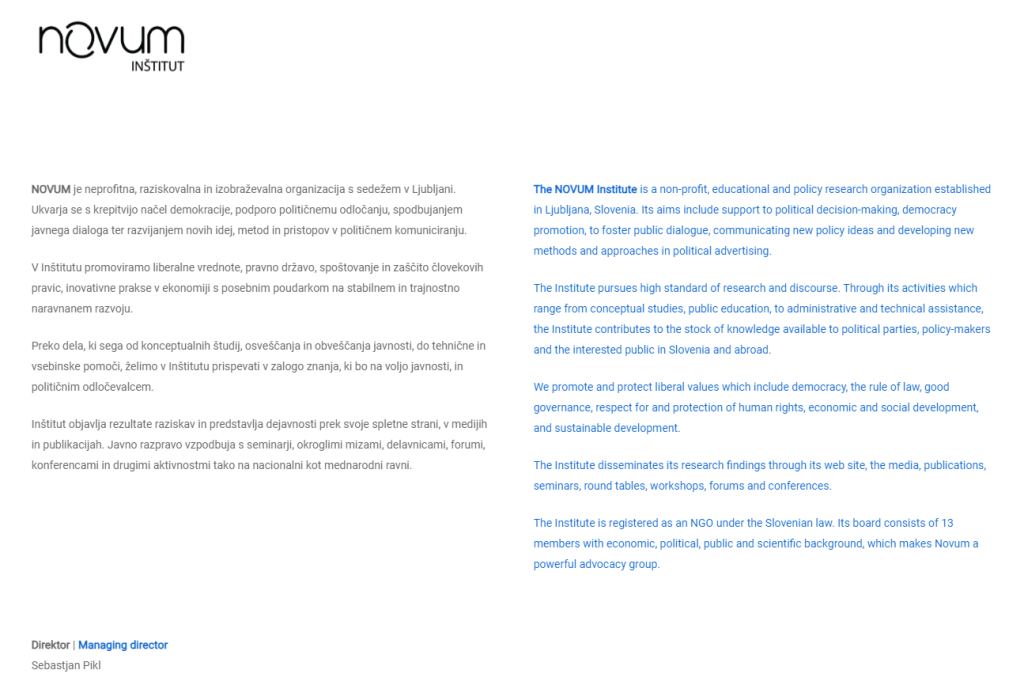
The NOVUM Institute is a non-profit, educational and policy research organization established in Ljubljana, Slovenia. Its aims include support for political decision-making, democracy promotion, fostering public dialogue, communicating new policy ideas and developing new methods and approaches in political advertising. The Institute pursues high standards of research and discourse. Through its activities which range from conceptual studies, public education, to administrative and technical assistance, the Institute contributes to the stock of knowledge available to political parties, policy-makers and the interested public in Slovenia and abroad.
South Korea
The Asia Democracy Network (ADN) is active in more than 40 countries in Asia. Our core values are to promote and practice the principles of democracy through the development of inclusive governance, advancement of human rights, equality and inclusivity, prevention of discrimination, human security, promotion of free, fair and meaningful elections, democracy education, & press freedom and responsibility.

Seoul
East Asia Institute
The East Asia Institute (EAI) is a non-profit, independent, private think tank founded in 2002 with the mission of seeking to establish a regional community based on democracy and a market economy.

The Peace and Democracy Institute (PDI) is a research organization affiliated with Korea University’s Department of Political Science and International Relations. The PDI seeks to produce high-quality social science research contributing to the establishment of a political order based on peace, prosperity, and justice on the Korean Peninsula and in the surrounding region.

Spain
Madrid
Club de Madrid
Club de Madrid is the world’s largest forum of democratic former Presidents and Prime Ministers, who leverage their individual and collective leadership experience and global reach to strengthen inclusive democratic practice and improve the well-being of people around the world. This unique alliance stimulates dialogue, builds bridges and engages in advocacy efforts to strengthen public policies and effective leadership through recommendations that tackle challenges such as inclusion, sustainable development and peace, at the national and international levels.

Madrid
Elcano Royal Institute
The mission of the Elcano Royal Institute is to contribute to innovative, robust, inclusive and informed responses to global challenges and governance and to analyse the role of Spain in the world, with a particular emphasis on its position in Europe. The institute analyses the international outlook and assesses how major global transformations affect Spanish society. Our objective is to provide ideas that promote and strengthen sustainability, peace and security, prosperity, the reduction of inequalities, democracy, freedom and human rights, and equality between women and men.

Madrid
Fundación Alternativas
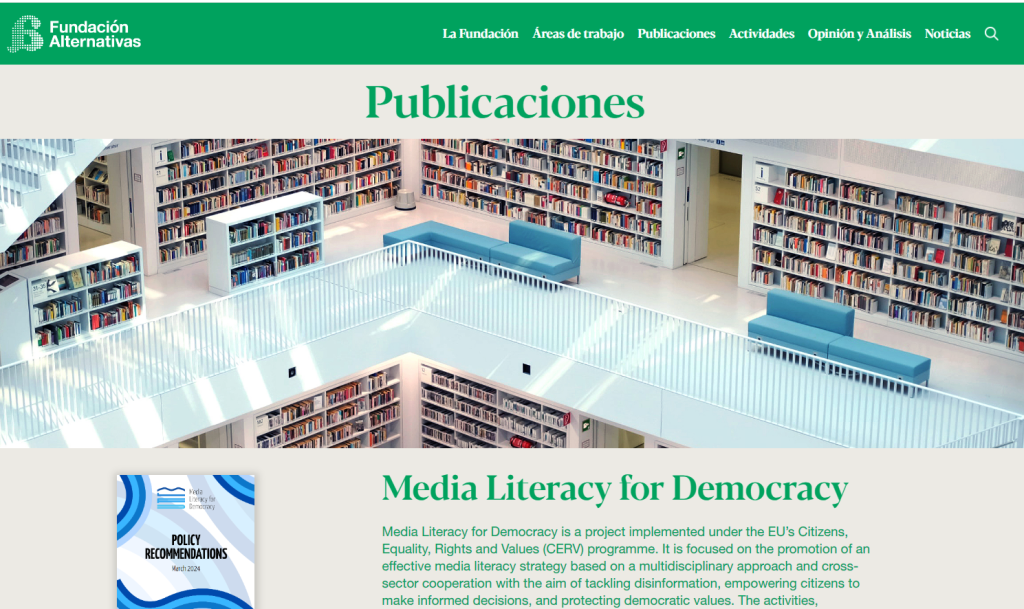
The Alternativas Foundation is an independent centre for thought, discussion and development of ideas for political, economic, social and cultural change in Spanish and European society. The Foundation’s mission is to contribute to progressive theoretical and cultural thought and to help build bridges of dialogue and collaboration between various political and social groups. In 2024 the organisation published a report called Media Literacy for Democracy which focused on the promotion of an effective media literacy strategy based on a multidisciplinary approach and cross-sector cooperation with the aim of tackling disinformation, empowering citizens to make informed decisions, and protecting democratic values.
Sri Lanka
The Centre for Policy Alternatives (CPA) was formed in the firm belief that there is an urgent need to strengthen institution and capacity-building for good governance and conflict transformation in Sri Lanka and that non-partisan civil society groups have an important and constructive contribution to make to this process. The primary role envisaged for the Centre in the field of public policy is a pro-active and interventionary one, aimed at the dissemination and advocacy of policy alternatives for non-violent conflict resolution and democratic governance. Accordingly, the work of the Centre involves a major research component through which the policy alternatives advocated are identified and developed.

Colombo
Verité Research
Verité Research is an independent think tank that provides strategic analysis for Asia in the areas of economics, politics, law and media.

Sweden
Stockholm
Democracy Tracker
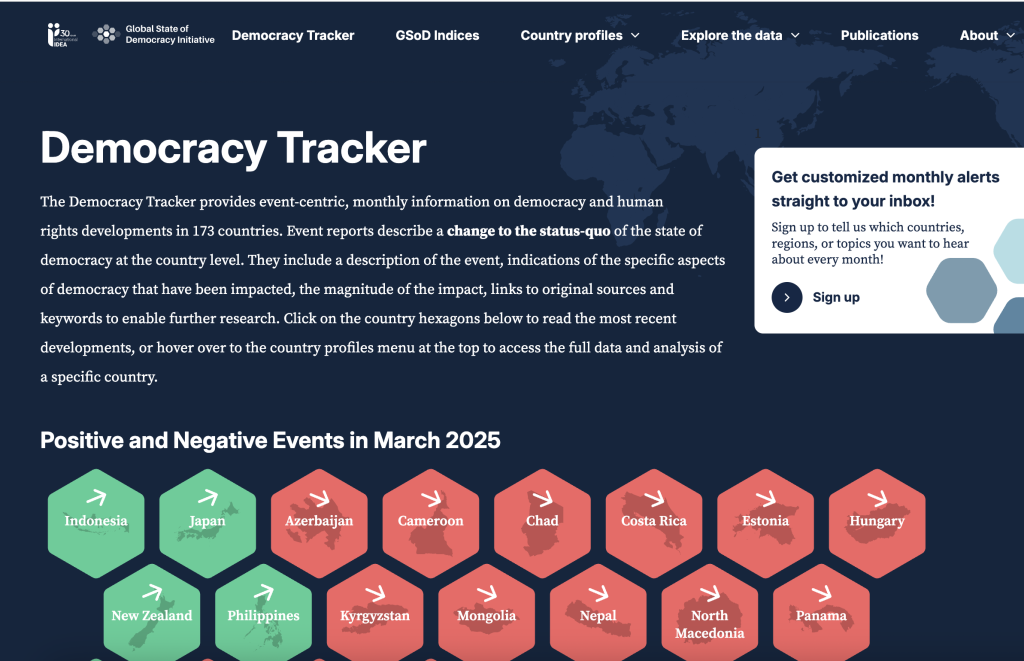
A project of the International IDEA The Democracy Tracker provides event-centric, monthly information on democracy and human rights developments in 173 countries. Event reports describe a change to the status-quo of the state of democracy at the country level. They include a description of the event, indications of the specific aspects of democracy that have been impacted, the magnitude of the impact, links to original sources and keywords to enable further research.
International IDEA advances, promotes and protects sustainable democracy worldwide in consideration of human rights commitments through policy-relevant knowledge, capacity development, advocacy, and the convening of dialogues. We develop, share and enable the use of comparative knowledge, assist in democratic reform, and influence policies and politics.

ICLD’s mission is to support democratic participation and change at the local level. With its focus on local democracy, local self-governance and decentralisation, ICLD strengthens local governments’ capacity to analyse, prioritize and implement Agenda 2030 in accordance with their own needs, priorities and resources. The unique combination of practice and theory is a major asset of ICLD.

Stockholm
Swedish International Liberal Centre
SILC is a liberal aid foundation that promotes democracy and human rights. By empowering activists in totalitarian states, we support their struggle to overthrow dictatorships and build democracy. They collaborate with parties and civil society organizations to support their struggle for democracy. A recurring theme is to strengthen the participation of women and young people.

Gothenburg
V-Dem Institute
Varieties of Democracy (V-Dem) is a unique approach to conceptualizing and measuring democracy. V-Dem distinguishes between five high-level principles of democracy: electoral, liberal, participatory, deliberative, and egalitarian, and collects data to measure these principles.

Switzerland
The Albert Hirschman Centre on Democracy explores the plurality of democratic experiences and aspirations in an interdisciplinary and comparative perspective.
The Centre for Democracy Studies Aarau operates the Democracy Barometer a database on referendums and a database on Swiss elections and votes. Teachers can find materials, information and suggestions for teaching political education on a selection of platforms on the subject of political education.
Geneva Institute for Democracy and Development (GIDD) serves to further public education through the production and dissemination of accessible commentary and scholarship. The institute aims to provide a balanced and thoughtful perspective on topical issues, promoting open and rational debate based on evidence rather than ideology. GIDD believe that democracy is the foundation of a free and just society. It is the cornerstone of peace and prosperity, and it is essential for the protection of human rights and the rule of law. GIDD also believe that democracy is a dynamic and evolving process that requires constant attention and support.

The Initiative and Referendum Institute Europe (IRI Europe), founded in 2001, is a European think tank dedicated to research and education on procedures and practices of modern direct democracy. The Institute’s main mission is to develop insights into the theory and practice of modern direct democracy among politicians, the media, NGOs, academics and the public throughout Europe – and beyond.
Geneva
Kofi Annan Foundation
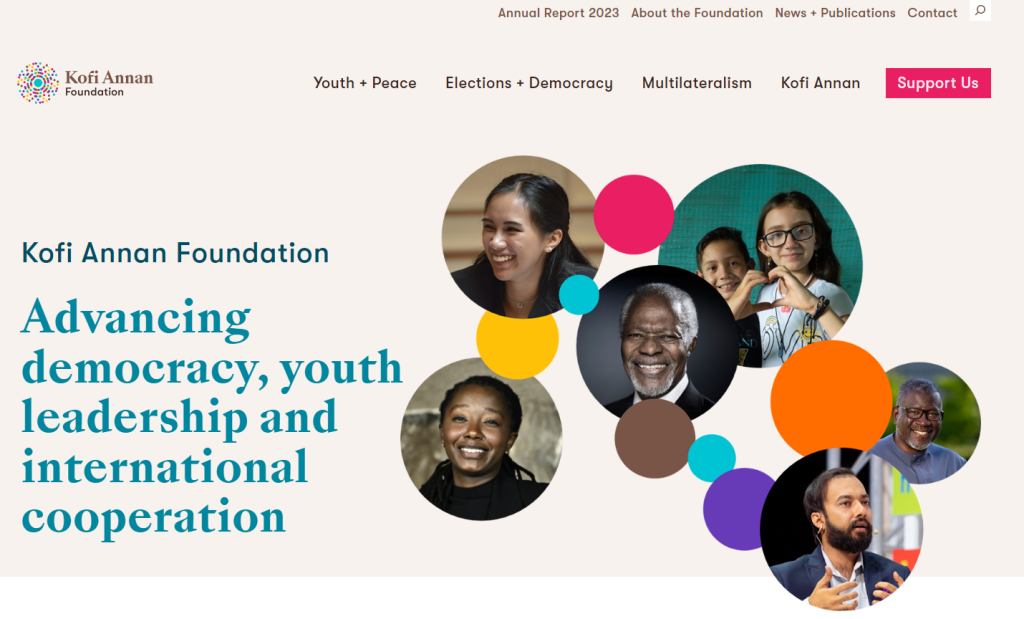
The foundation’s mission is to build on Kofi Annan’s legacy for peace by advancing democracy, youth leadership and international cooperation. It works for a fairer and more peaceful world, where no one is left behind, democratic principles and the rule of law are upheld, and divides are bridged through dialogue and international cooperation.
The Swiss Democracy Foundation implements projects and works with partners to protect and develop democracy, with a particular focus on citizen participation, tolerance towards minorities and international understanding. The foundation has undertaken a range of projects including: the Youth and Democracy fund, the Global Forum on Modern Direct Democracy, and the Direct Democracy Navigator.

Thailand
Bangkok
Asian Network for Free Elections
ANFREL’s main efforts are focused on conducting international election observation missions, developing capacity building programs for electoral stakeholders such as domestic election observer groups, media, and other civil society organizations working for democratization in their home countries, and undertaking campaign and advocacy activities to address electoral challenges and related issues encountered in the development of democracy in Asia.

The strategic vision for IAS is to continue to serve the Thai community and the Asian region as a source of knowledge and expertise for a broad range of subject areas in the region including economic, social, political, and security concerns.

Timor Leste
CEPAD is a Timorese NGO that was established in 2007 in response to the country’s 2006 military conflict. Its mission is to use collaborative research and interactive dialogue to advance the understanding of conflict-related issues and the major challenges to the consolidation of democracy in Timor-Leste

JSMP now exists as a Timorese led not-for-profit organization working to improve the judicial and legislative systems in Timor-Leste, through advocacy to promote legality, transparency, accountability and the rule of law. Aims to work in a spirit of collaboration to improve and protect democracy, law, justice and human rights

Türkiye
Istanbul
Al Sharq Forum
Al Sharq Strategic Research aims to consolidate the values of pluralism and justice while developing long-term strategies and programs that contribute to the political development, economic prosperity, and social cohesion for the people of the Al Sharq region and the world.

PODEM seeks to contribute to the efforts towards a Turkey where democracy is fully institutionalized and where a democratic mindset prevails. PODEM further envisions a Turkey that is increasingly influential in the establishment of peace and justice on social, regional, and global levels.

PODEM seeks to contribute to the efforts towards a Turkey where democracy is fully institutionalized and where a democratic mindset prevails. PODEM further envisions a Turkey that is increasingly influential in the establishment of peace and justice on social, regional, and global levels.
The Women and Democracy Association, KADEM, was founded on International Women’s Day, March 8th 2013, as a non-governmental and non-profit organization working for the empowerment of women. KADEM is engaged in advocacy in order to deliver the human dignity women deserved and has a mission of carrying out solution-oriented best practices to solve the issues and barriers that inhibit women’s most basic rights. KADEM aims to be a leading and accessible NGO with our national and international activities based on the principle of equality in existence and justice in responsibilities as they pertain to issues about women.

Ukraine
The fund belongs to the leading analytical centres in Ukraine, which successfully combines public opinion research with the analysis of politics and key socio-political processes, develops reasoned proposals for decision-making bodies, as well as for the public in the field of democratic transformation of Ukraine and its integration into the European community democracies.

The International Renaissance Foundation (IRF) is one of the largest Ukrainian charitable foundations that has been developing an open society in Ukraine since 1990 where everybody has a sense of dignity, citizens are involved in the formation of the state, and the authorities are transparent and responsible. The foundation works on the development of Ukraine in which human rights are securely protected and positive changes work for the benefit of the citizens. It also helps preserve stable democracy in Ukraine and make Ukrainian governance transparent and accountable.

United Kingdom
ACT is the subject community for Citizenship teachers and educators. Citizenship education develops knowledge, skills and understanding that pupils need to play a full part in democratic society, as active and informed citizens. Pupils are taught about democracy, politics, parliament and voting. Additionally, they learn about human rights, justice, the law, identities and diversity. Topics such as media and information literacy, climate change and sustainability, financial and economic education and the role of the UK in the wider world are also included.

The centre’s goal is to identify threats to democracy and investigate strategies that ensure the resilience of democracy. We encourage research informed by a wide range of theoretical and methodological positions. Our current projects include investigating democracy in the information age, and the challenge of increasing higher participation in democratic decision-making.

The Centre for the Study of Democracy (CSD), established in 1989, is based in the School of Social Sciences at the University of Westminster. At the Centre, academics working in politics and international relations undertake socially engaged, methodologically diverse and often interdisciplinary research that aims to address a range of critical political challenges in relation to democracy worldwide. CSD has a longstanding international reputation for research excellence through a programme of publications, events and collaborations with academics, practitioners, policymakers, and activists.

London
Chatham House
A major focus of Chatham House research is to examine the value and future of democracy in a changing world and its role in supporting an international order increasingly under threat from nationalist and populist attitudes. Analysing a wide range of political and social issues helps create a better understanding about why both political attitudes and public opinion within a society can be hugely diverse and challenging to manage well.

London
Democracy Network
The Democracy Network is a network of people and organisations working on issues of power, democracy and voice in England, Scotland, Wales and Northern Ireland. The network supports each other to connect and collaborate, share and learn, build a way to agree ways forward, and take action and influence decision makers together.

London
Demos
Demos believes that there is a better way: one which puts people first to achieve fundamental and lasting change and overcome divisions. This is called collaborative democracy. As a genuinely cross-party think tank, Demos work with all parties to find solutions that work for more people.

London
Economist Intelligence Unit
EIU’s Democracy Index report analyses the relationship between democracy, war and peace and looks at the geopolitical drivers of conflict. It also provides an explanation of the changes in the global rankings and an in-depth regional overview.

Colchester
ECPR Standing Group on Democratic Innovations
The ECPR Standing Group on Democratic Innovations aims to build a global community of scholars interested in reforming democracy through practices that place citizens at the centre of politics and governance. The Standing Group (SG) is an inclusive community, welcoming academics from various theoretical, methodological, and empirical traditions.

London
openDemocracy
openDemocracy is an independent international media platform. The organisation produces high-quality journalism which challenges power, inspires change and builds leadership among groups underrepresented in the media. It helps voices that are otherwise excluded from the media to reach larger audiences, and campaign on key stories, pushing for a more open, democratic and egalitarian world.

WFD have actively helped democracies to grow stronger, so that freedom and prosperity can flourish. WFD help solve problems of democracy so that democracies can address challenges that people face around the world – from climate change to corruption. The foundations strategy sets out its vision of a world in which freedom and democracy thrive, and where inclusive and accountable governments serve people fairly and effectively.
